Showing posts with label toddlers. Show all posts

Tuesday, August 16, 2016

Ways to Help Toddlers that Stutter

In the United States, over 3 million Americans who stutter.  Educators and peers may perceive toddlers who stutter as shy, nervous, anxious, withdrawn, self-conscious, tense, less competent, introverted and insecure.


Speech and language skills develop at a fast pace when children are toddlers. Toddlers learn new words almost every day. Toddlers are learning how to say the sounds in the words they know. They are also learning how to structure sentences in a way that a person understands and gets them what they want. 

Toddlers have a lot of information they want to communicate. However, they do not always have the skills to communicate all of the information they want to say to someone. Therefore, it is not uncommon for children between the ages of 2 and 5 to stutter. The stuttering may come and go or last for a couple of weeks. If stuttering disappears and then returns they may be going through another stage of learning language.  

Below are ways to help toddlers that stutter and when to refer to a speech language pathologist (SLP). If you have any questions please feel free to contact us directly at 972-608-0416. 

Ways to Help Toddlers that Stutter

  • Do not make a big deal about the stuttering. 
  • Remain calm when children stutter. Children become frustrated if you are frustrated. 
  • Create opportunities for talking that are relaxed, fun, and enjoyable.
  • Take the pressure off children.  Show them that you are interested in what they are saying and give them time to communicate information.
  • Model a slower rate of speech. When caregivers talk fast it puts pressure on children to talk at the same rate of speech. Toddlers do not have the ability to get their thoughts out as fast as an adult. 
  • Keep things simple. Ask one question at a time. This enables children to focus on one answer. Multiple questions can put pressure on a child to recall all of the questions and communicate the answers. 
  • Comment on what the child has said rather than asking questions. If a child says “Look at my car” a simple comment (e.g., “Wow, that’s a fast car”) will put less communicative pressure on the child than a question (e.g., “Is it fast?”)
  • Develop a successful communication environment without distractions or interruptions. Distractions and interruptions stop the thought process and will make it more difficult for the child to communicate information. 
  • Be positive about every communication attempt. Making comments like "Slow down,"  "Stop and take a deep breath," “Say it this way” should not be used.  They may be meant to help children, however, they can actually make children more self-conscious. If children become self conscious they typically limit the information they communicate. Children need to communicate to develop their expressive language skills
  • Set up successful talking situations. Don't put pressure on your child to entertain or interact verbally with other people when stuttering becomes a problem. Encourage activities that do not involve a lot of verbal interaction.


Refer to an SLP when a Child:
  • Repeats sounds of words such as c-c-c-c-carrot or ca-ca-ca-carrot.
  • Holds out sounds in words “mmmmy truck is red.”
  • Shows tension in the muscles of the face or body during stuttering moments.
  • Substitutes or deletes sounds and is difficult to understand.
  • Demonstrates language skills that are above or below their peers. Children with advanced language skills may have trouble communicating all of the information that they know. 
  • Exhibits hitting or biting. Children may hit or bite because they are frustrated due to not being able to communicate the words they want to say or are afraid of stuttering.
  • Has been stuttering longer than 6 months.
  • Began stuttering after age 3 ½. 
  • Has another member in the family that stutters.

Achieve Hearing & Rehabilitation is a speech and hearing clinic with locations in Plano and Dallas, Texas. We offer speech language pathology and audiological services to children and adults of all ages, and resources to help you target your specific speech therapy needs.  If you or someone you know demonstrates any signs stuttering, please call us at 972-608-0416 to discuss how Achieve can help. 

Achieve a Balanced Life
Tuesday, August 25, 2015

Reading to Children


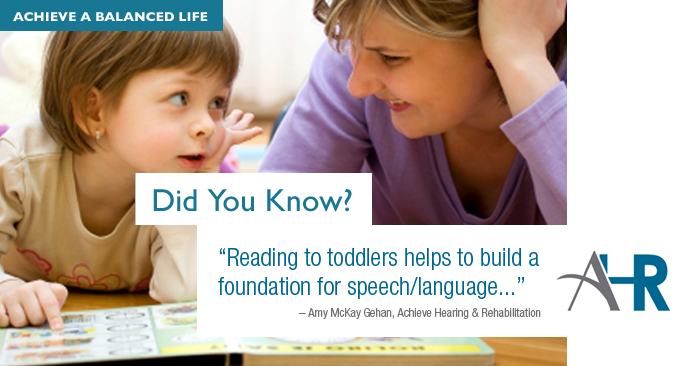
Reading the same books to your child, especially to your newborn children with the same intonation (rise and fall of your voice) will help soothe your child while building a foundation for his speech/language.  The toddler (a child between the ages of 1 and 3) years are a time of great cognitive, emotional and social development.

In a study by Dr. Riscorla, Professor of Psychology, Director of the Child Study Institute and Director of Early Childhood Programs at Bryn Mawr College in Pennsylvania, very clearly showed that the children that were slow to talk were significantly less advanced in their language skills than comparison children who came from the same social class background and had the same level of non-verbal ability when they were toddlers.

The majority of children who are late to start talking will outgrow this slow start and they’ll learn to read, and they’ll be able to function adequately throughout their school years. And this should be a message that we can give to parents to really reassure them that most late takers will do okay. As children get older more aggressive intervention may be required. 

Dr. Rescorla developed the Language Development Survey, a screening tool for language delay in toddlers which indicates, children who are late talkers may have a weaker language endowment, and in this case it can help for parents to provide some enrichment in the child’s language environment early on. They can use techniques like shared book reading, or be taught focused stimulation or other communication techniques, and all these can provide a rich language environment that may have some facilitative effects. Dr. Rescorla encourages parents to have the child’s language development monitored by a speech language pathologist and to initiate direct intervention if significant growth isn’t seen by age three.

Former Secretary of State Hillary Rodham Clinton visited  SCO Family of Services to jointly launch New York City’s “Talk To Your Baby, Their Brain Depends On It” public awareness campaign, urging parents to talk, read and sing to their babies from birth. These efforts will focus on closing the “word gap.” Studies have found that by age four, children in middle and upper income families hear 30 million more words than their lower-income peers. This disparity in hearing words from parents and caregivers translates directly into a disparity in learning words. And that puts our children born with the fewest advantages even further behind. “Everybody needs to be creative and smart about how we better prepare our kids for the future,” said Secretary Clinton.

Listen to Hillary Clinton on The Tonight Show Starring Jimmy Fallon talking about the importance of reading to your baby:


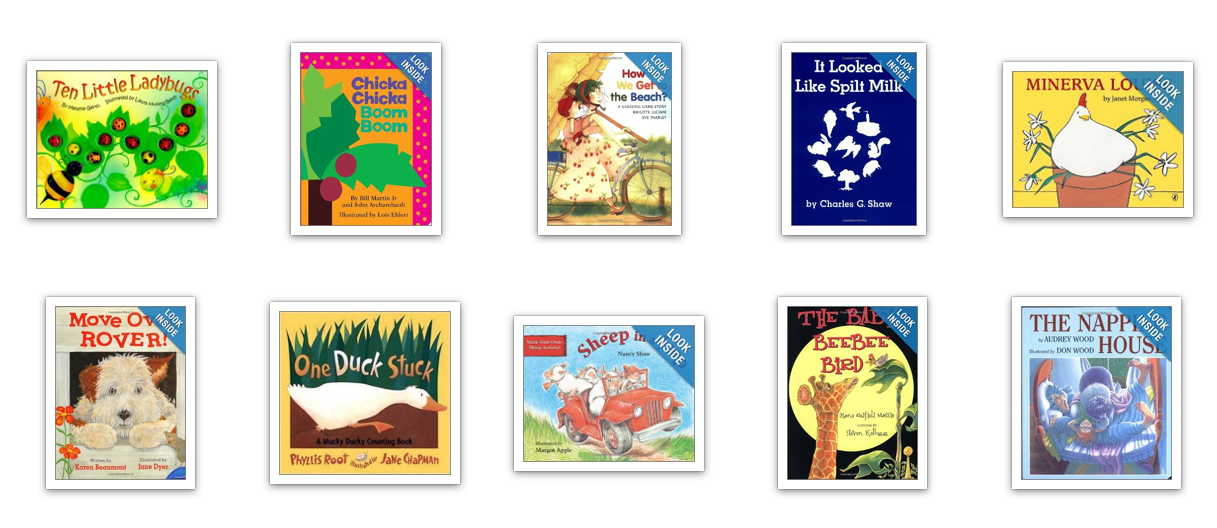
The following books are for reading to Toddlers 


Author: Audrey Wood

Author: Diana Redfield Massie

Author: Nancy Shaw

Author: Bill Martin Jr.

Author: Melanie Gerth

Click here for more books that are categorized by age group for reading

Early intervention help provided by Achieve Hearing & Rehabilitation, includes the family as part of the team to work together to make sure the child’s needs are being met.  To schedule an appointment call us today 972-608-0416 or send email questions to receptionist@achievehearing.com

Achieve a Balanced Life

Reference:

SCO Family of Services
Bryn Mawr Child Study Institute